-
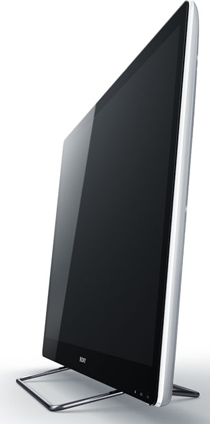 Networks Block Google TV Access to Sites[teaser]ABC, NBC and CBS shows are unwatchable on Google TV, even through the internet browser. [/teaser] At this point, it seems like hooking a netbook or HTPC to your television is going to be the best solution. Google TV holds a great deal of promise, but the lack of support from content providers may make the new product a hard sell. The problem seems to be that the networks don't want folks using Google TV to watch web based versions of their shows. It's not good for the ratings, and it could hurt their advertising revenue. There's also a concern of people viewing on pirate sites, rather than the network's own website. For now, Hulu, ABC, NBC and CBS will all be blocking you from access when you pick up your Google TV. The folks at Google are working on it, but don't expect to hear anything soon. Source: Wall Street JournalPosted Tue Oct 26, 2010 at 12:20 PM PDT by:
 -
 Xpand Universal 3D Glasses Available Now[teaser]A solution to the 3D glasses incompatibility issue is here, and it's reasonably priced to boot. [/teaser] Remember back in May when we found out that the solution to getting Panasonic glasses to play nice with Samsung sets was to wear them upside down? Finally there's a better way. Now don't get crazy and assume that the companies who make said 3D glasses and sets decided to work on compatibility – this is a third party solution. A company known as Xpand has officially launched its own universal 3D glasses that are guaranteed to work with every single active 3D television on the market. They won't do passive 3D tech, but you probably wouldn't want to shell out real money for passive tech 3D glasses anyway, would you? You can pick up the Xpand Universal 3D Glasses now on Amazon. They've got an MSRP of $129, but are currently selling for $107.67, a 12 percent discount from the suggested price. Source: AmazonPosted Tue Oct 26, 2010 at 11:00 AM PDT by:
 -
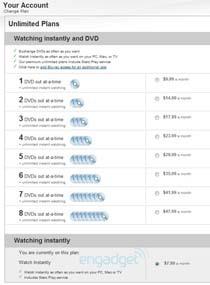 Netflix Testing Streaming Plans – Other Subscription Fees May Rise[teaser]There's a bit of discrepancy in pricing strategies, but it looks like Netflix might force you to pay more for Blu-ray once again. [/teaser] The folks over at Engadget noticed something strange today when they looked at their Netflix accounts. Where there used to be a disc-free Starz Play option, there was now an option for unlimited streaming. Pricing though, seemed to depend on a few different things. On one computer, there was an option for a $7.99 plan with unlimited streaming and no discs. On another, the price was $8.99. The one with the $7.99 option also saw the disc by mail subscription price increase by a dollar a month. It's more than a little confusing, but from the sound of things, you'll be able to knock off a dollar or two for choosing the instant streaming option, while sticking with DVDs and Blu-rays means an increase in the cost of your subscription. Source: EngadgetPosted Tue Oct 26, 2010 at 09:00 AM PDT by:
 -
 The Rachel Ray Show Brings "Full Color 3D"[teaser]3-D Vision's new tech is said to be an improvement over the red and blue glasses of yore. [/teaser] This is where it all starts to get confusing. Not for High-Def Digest readers of course, you're cool and plugged in and you understand the whole 3D thing. But your relatives, friends and co-workers don't, and a promo like this is bound to raise more than a few questions. The special Halloween 'Rachel Ray Show' is going to be shown in a new kind of 3D that strongly resembles the old kind of 3D. The new tech from 3-D Vision uses the same kind of cheap cardboard glasses – they'll be given out in TV guide if you're interested – and multicolored lenses as anaglyph 3D. The changes made by 3-D Vision provide full color 3D, and eliminates the brightness imbalance experienced by viewers. The episode will air on October 29th and will feature magicians Penn and Teller as well as an appearance from Pee-wee Herman – yes, that Pee-wee Herman. You'll be able to view it on any TV, whether it's 3D ready or not. Source: 3-D VisionPosted Tue Oct 26, 2010 at 07:00 AM PDT by:
 -
 Rumor: Hulu Plus Dropping Price to $4.95 a Month[teaser]A more reasonable pricing scheme could make Hulu Plus a lot easier to justify. [/teaser] When Hulu Plus was first announced, it seemed so ripe with possibility. The promise of watching all the shows you want whenever you want captured our attention. It was a grand slam, but Hulu failed to follow it up. Content on Hulu Plus is lacking, shows are still delayed, and the much anticipated launch of the service on consumer devices hasn't happened yet. From the sound of things, people haven't been as quick to adapt the Hulu Plus service as the company had hoped. Peter Kafka over at All Things D has some inside information on the subject. According to his source, Hulu is planning on slashing subscription costs from $9.95 a month to $4.95 a month which would bring it down to a more appropriate price. Source: All Things D via EngadgetPosted Mon Oct 25, 2010 at 11:00 AM PDT by:
 -
 How the Studios Lost Out on Netflix[teaser]If things had gone a little bit differently back in 2002, we could be seeing a very different Netflix right now. [/teaser] Story time. The year is 2002 and a fledgling DVD-by-mail company known as Netflix goes public. Warner Bros makes a deal for pre-IPO stock in the company, and the rest of the studios jump on board. The company moves slowly, and the major studios sell their stock. Somewhere back in 2008 things started to change for the company. Streamed content was gaining popularity thanks to inclusion on the Xbox 360 and more devices were soon to follow. Now Netflix has become a giant in the industry, with stock trading at around $170 a share. Of course, if the studios had held on to their stock it's unlikely we'd still have the service we have today. Source: The WrapPosted Mon Oct 25, 2010 at 09:00 AM PDT by:
 -
 Roxio Will Be Launching on More Devices than Ever[teaser]Hundreds of consumer electronic devices will be using Roxio this fall. [/teaser] The guys at Sonic Solutions have found a great deal of success in their Roxio platform. Sure, the Roxio service didn't take off like Netflix did, but Sonic Solutions is not powering a variety of different web based video offerings. Companies like Blockbuster and Best Buy use the Roxio backbone for their sales and rentals, and that's big business. Sonic announced today hundreds of new devices would be carrying the Roxio distribution platform this holiday season. The list of makers includes the usual suspects like LG, Onkyo and Panasonic, but also some unexpected names like Sylvania, Memorex and HTC. Source: Sonic SolutionsPosted Mon Oct 25, 2010 at 07:00 AM PDT by:
 -
 Panasonic's Hall of Fame Inductees and 3D Award[teaser]It's award season at Panasonic, even if one of those awards seems a little less than legitimate. [/teaser] Panasonic has been championing 3D technology from the start, which is why the company received the first annual Charles Wheatstone award. It was given to them by the International 3D Society, of which Panasonic is a significant member. It's a nice honor, but it seems a little like helping to create a club and then giving yourself an award for doing so. More significant were the inductions of Richard Kraft and Dr. Larry Weber into the Consumer Electronics hall of fame. Kraft is a former president of Panasonic North America and is the first American to ever hold that position. He helped spearhead the HD movement and helped to revitalize the company and put it in a position that would make it competitive in the HD TV market. Dr. Weber helped to create the energy recovery sustain circuit as well as other key technologies that aided in bringing plasma technology to the forefront. Source: PanasonicPosted Mon Oct 25, 2010 at 06:30 AM PDT by:
 -
 Around the World in 80 HD AdvisorsEditor's Note: Each Friday, High-Def Digest's own HD Advisor will answer a new round of questions from our readers. If you have home theater questions you need answered, send an email to [email protected]. If you've already sent a question and don't see it answered yet, please be patient as we work our way through them. To browse through previously answered questions, visit the main HD Advisor page. Answers by Joshua Zyber Audio Jitter Q: I use a PS3 as my main media center. I recently was forced to switch from an original "fat" PS3 to a PS3 Slim since the fat one died on me. I began reading up on the differences between the two systems and found that the PS3 Slim produces more audio jitter when watching DVDs and CDs. What is audio jitter, and will it really affect the technical performance of the film? Basically, can I hear it? A: Jitter is one of those things that audiophiles like to stress-out about. For the rest of us, in real practical terms, if you don't notice anything wrong then you probably shouldn't worry too much about it. Any sort of digital data transmission, including audio, will be sent from source (Blu-ray player) to destination (A/V receiver) as a stream of 1s and 0s. Assuming the connection is sound, the destination should receive all of the 1s and 0s, and receive them in the proper order, thus allowing it to decode that signal. However, jitter is a variation in the timing of those 1s and 0s. Some may arrive just a little bit early, and others may arrive just a little bit late. If the jitter is severe, that can lead to audible distortion or degradation of the sound signal. Think of it like listening to an old LP on a record player with an unstable motor that randomly speeds up and slows down how fast it spins the disc. That's an exaggerated example, of course, but it may help to demonstrate how timing can affect the audible results. In the past, I'd always been told that transmitting audio in PCM format was more susceptible to jitter issues than transmitting in either Dolby or DTS bitstream formats. Audio compression codecs (whether lossy or lossless) packetize the data and require clocking mechanisms in the receiver that should minimize or eliminate jitter. However, this paper claims just the opposite, that bitstream transmission is more susceptible to jitter. Honestly, at this point, I'm not sure what to believe. I'll leave it to our audiophile readers to argue this out in the forums. [Update: As pointed out by a reader, that paper was actually referring to data storage on the disc, not transmission method. My initial understanding was correct that "bitstream" transmission should not suffer from jitter.] Early CD players and audio receivers that transmitted linear PCM over S/PDIF connections (either Toslink optical or digital coax) were quite prone to jitter, which is what launched so much consternation over the subject in the first place. Most modern equipment uses data buffers and clocking circuitry that should mitigate the problem. I'm not saying that jitter doesn't exist anymore or that no one can hear it. Let's just say that some people are more sensitive to it than others. Or at least claim to be. Since you'd previously owned the old version of the PS3 and now have the newer PS3 Slim, I'd simply recommend that you watch a bunch of movies and decide for yourself whether you hear anything different or "wrong." If nothing stands out to you, then I suggest that there's no reason to stress about it. Just enjoy your movies. Center Channel Volume Q: I'm just curious as to what decibel levels above I should put my center channel speaker at? If I leave it the same level as my front and rears, then it's too low. I'm using a sound level meter. A: Generally speaking, you should calibrate all of your speakers to read the same decibel level with test tones. Movie soundtracks are mixed in that fashion, and with the expectation that you will listen accordingly. However, it's very possible that acoustic conditions in your room may affect the audibility of dialogue from the center channel. If your A/V receiver offers any sort of automated calibration program such as Audyssey MultEQ, it may be worth giving that a try. In addition to setting speaker volume levels, these programs often also adjust equalization settings to "correct" sonic problems in the room and improve audibility. While I'm not necessarily 100% sold on these techniques in all circumstances (sometimes this sort of fiddling with the signal does more harm than good), it may be worthwhile if you have a consistent problem hearing dialogue. It's also worth noting that many modern movies (especially action and sci-fi movies, but not necessarily limited to those genres) are mixed extremely "hot," with (sometimes excessive) dynamic range that causes dialogue to be drowned out by music and sound effects. Last year's 'Transformers: Revenge of the Fallen' was a big offender in this regard. I find this tendency really obnoxious and grating. In these situations, you may find benefit in raising your center channel volume a little bit to compensate. But there isn't going to be one magic setting that will work for every movie, so you'll just have to set it to taste, and remember to change it back when the movie is over. Homework Assignment: You Be the Advisor The HD Advisor knows many things, but he doesn't know everything. Some questions are best answered with a consensus of opinions from our readers. If you can help to answer the following question, please post your response in our forum thread linked at the end of this article. Your advice and opinions matter too! Vertical Stripes in 'First Blood' and 'Broken Arrow' Q: I was recently watching the Blu-ray release of 'First Blood.' I noticed in some of the shots what appeared to be a series of several dozen vertical stripes of slightly higher brightness. It was most noticeable in the scene where Col. Trautman is first talking to Rambo over the radio. The shots with Rambo look perfectly normal, but the shots of Trautman inside the tent have these parallel, vertical lines of alternating brightness. I remember noticing the same thing on a number of the desert shots when I watched 'Broken Arrow' a little while back. However, I had watched the two movies on two different Blu-ray players (DMP-BD60K and BD-P1000 respectively), but on the same television. I didn't see any mention of the problems in the reviews of the movies, so I was wondering if there might be a problem with my television (a Panasonic TBM2AX03401). Is this possibly something on the source material, or could it be my setup? JZ: Has anyone else noticed this problem with either of these discs? Check back soon for another round of answers. Keep those questions coming. Joshua Zyber's opinions are his own and do not necessarily reflect those of this site, its owners or employees.Posted Fri Oct 22, 2010 at 11:00 AM PDT by:
 -
 Netflix Now Considers Itself a Streaming Company[teaser]A disc-free subscription plan could be on the way in the U.S. [/teaser] The folks at Netflix announced their earnings for the third quarter and, as you might expect, they were huge. They've got about 17 million subscribers now, and added four million of those in the last three months. CEO Reed Hastings cited the Netflix streaming service as the main avenue of growth and even went as far as to say that the focus of the company has shifted. "By every measure," says Hastings, "we are now primarily a streaming company that also offers DVD-by-mail." This declaration was soon followed by a suggestion that Netflix may start offering a streaming-only service for subscribers that don't want to worry about the discs. There's no word yet on when we'll see it and what the pricing will be, but you can expect it to resemble Canada's $7.99 streaming plan. Source: PR NewswirePosted Fri Oct 22, 2010 at 10:30 AM PDT by: